
Air Spring Test System
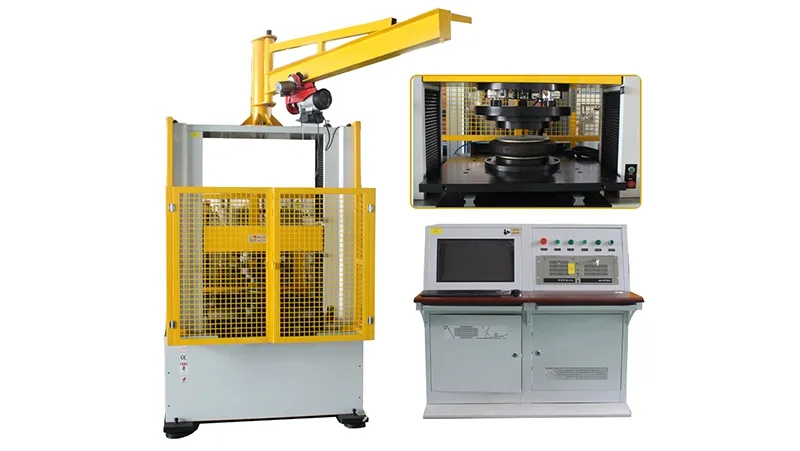
Technical Specifications
| Max. Test Force | ±100 kN |
| Effective Test Force Measurement Range | 1%–100% |
| Test Force Accuracy | ±1% |
| Min. Test Force Reading Resolution | 0.01 kN |
| Displacement Resolution | 0.01 mm |
| Relative Error of Test Force Indication | ≤1.0% within the measurement range |
| Testing Machine Accuracy Class | Class 1 |
| Displacement Indication Accuracy (L: Measured Distance, mm) | ±(50+0.15L) μm |
| Effective Test Stroke | 800 mm |
| Upper & Lower Platen Parallelism Error | ≤0.2 mm |
| Upper & Lower Platen Offset Error | ≤1.0 mm |
| Upper & Lower Platen Dimensions | 500 × 500 mm |
| Loading Speed | 0.001–500 mm/min (Stepless Speed Adjustment) |
| Speed Accuracy | ±1% of the set value (< 10 mm/min); ±0.5% of the set value (≥10 mm/min) |
| Overall Dimensions (L × W × H) | 1276 × 805 × 2276 mm |
| Machine Weight (Net Weight) | 750 kg |
| Machine Color (RAL K7 CLASSIC) | Main Unit: RAL6034; Protective Cover: RAL1016 |
| Total Power | 1.5 kW |
| Power Supply (Three-phase Four-wire, Grounding Required) | AC 380 V ±10%, 50 Hz |
Main Functions
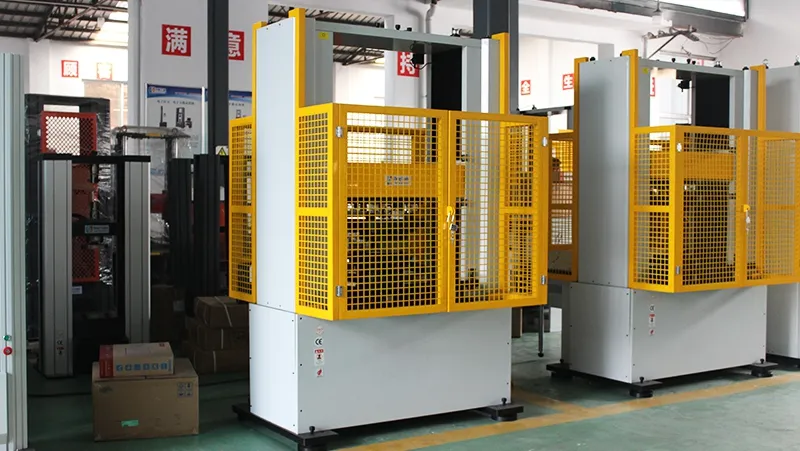
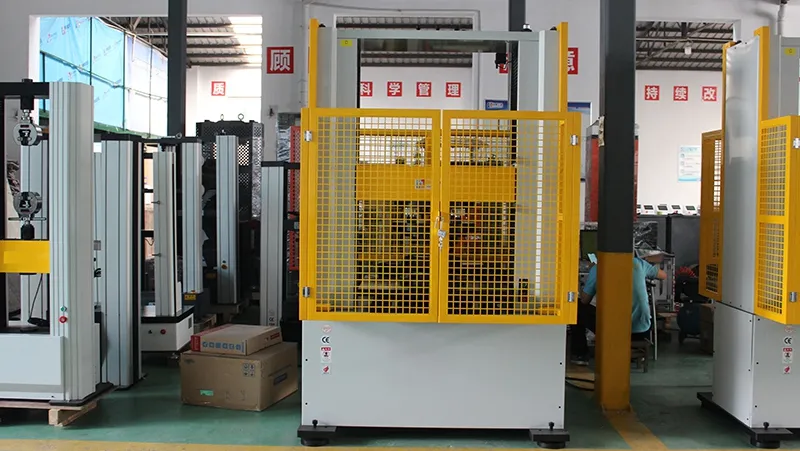
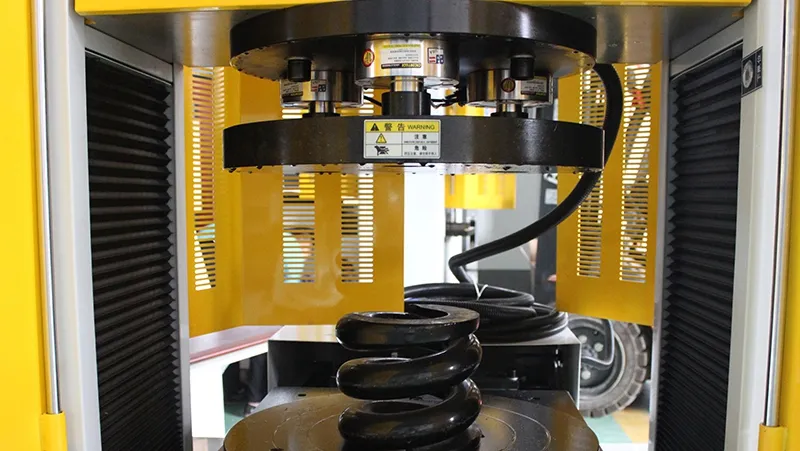
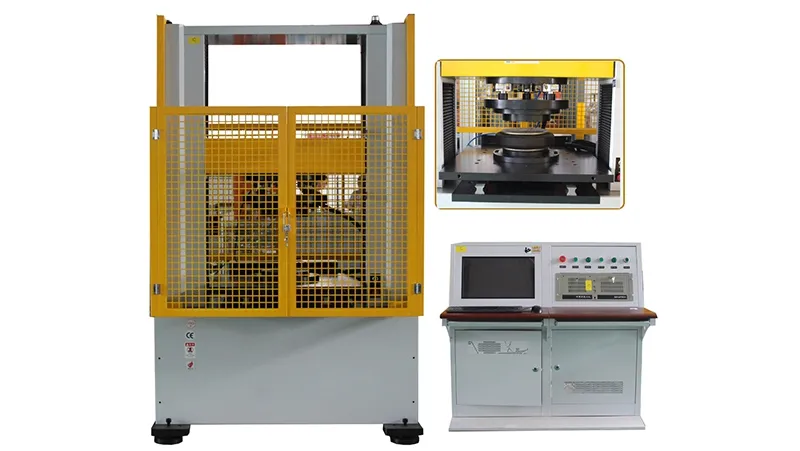
- The air spring test system performs static compression tests on elastomer components, including air springs, axle box springs, and rubber blocks, to evaluate their compression behavior under applied loads.
- The test system can perform constant load, constant displacement, and constant deformation tests. Its digital control system provides closed-loop control for load, displacement, and deformation, which allows smooth switching between these three control modes during testing without affecting the test process.
- It's equipped with protection functions for overload, drive system overcurrent, and crosshead travel limits. It stops automatically when the applied load exceeds 110% of the rated capacity, when overcurrent is detected, or when the crosshead reaches its maximum travel position.
- The load, displacement, and deformation measurement channels can be reset manually or automatically before testing to improve measurement accuracy.
- It automatically switches between measurement ranges according to the applied load, to ensure accurate readings throughout the testing process.