
Rubber Green Belt Building Line
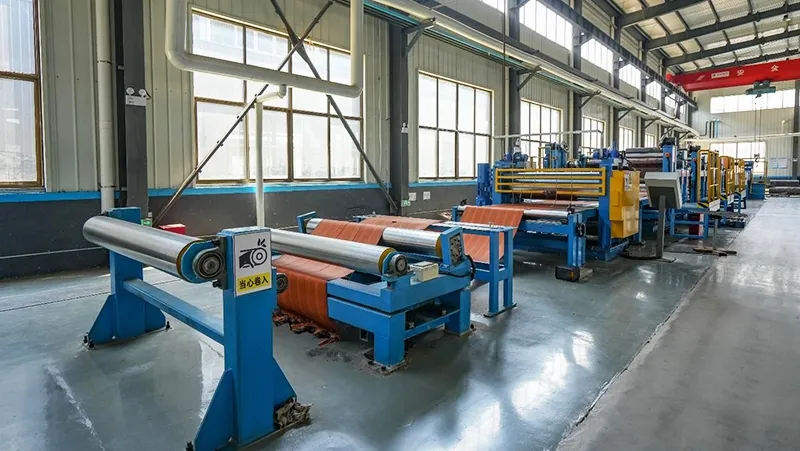
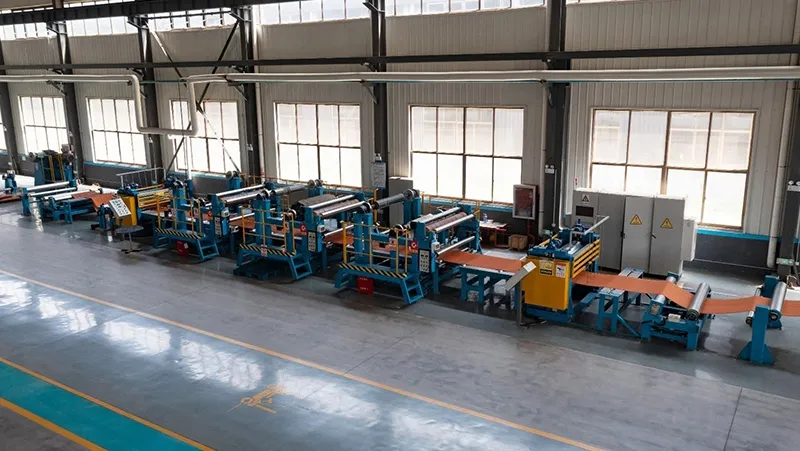
Rubber green belt lines for textile conveyor belts are used to build and prepare multi-ply belt structures before vulcanization. They handle layer assembly and rubber application for nylon, EP, and cotton fabric conveyor belts, helping ensure proper alignment and consistent structure during forming. The line uses controlled tension and guiding systems to support stable material handling. Flat wrinkle control is applied during fabric winding to help prevent deformation, while PLC-based control allows process parameters to be displayed and adjusted more easily. Automatic tension regulation and material tracking help maintain alignment throughout production, and multiple emergency stop points with safety guards are included to support safer operation.
- Product winding and unwinding unit (torque motor driven)
- Double and single unwinding systems
- Fabric winding and unwinding units (standard or constant tension type)
- Working table (integrated or conveyor-driven type)
- Automatic edge rubber application system
- Automatic rubber edge cutting unit
- Automatic adhesive application system
| Model | ||||
| Max. Belt Blank Width (mm) | 1200 | 1600 | 2200 | 2400 |
| Max. Belt Blank Thickness (mm) | 30 | 30 | 30 | 30 |
| Max. Belt Blank Diameter (mm) | 3000 | 3500 | 3500 | 3500 |
| Max. Belt Blank Weight (t) | 10 | 10 | 10 | 10 |
| Max. Forming Speed (m/min) | 5–30 | 5–30 | 5–30 | 5–30 |
| Max. Applicable Rubber Sheet Thickness (mm) | 1–20 | 1–20 | 1–20 | 1–20 |
| Tension Control Method | Tension brake | Tension brake | Tension brake | Tension brake |
| Edge Alignment Control System | Servo | Servo | Servo | Servo |
| Forming Table Length (mm) | 3000 | 3000 | 3000 | 3000 |
| Forming Table Width (mm) | 820 | 820 | 820 | 820 |
- Available in fixed tension and constant tension configurations to support different forming requirements
- Product winding and unwinding units driven by torque motors
- Double unwinding, single unwinding, and pad cloth winding and unwinding systems, available in fixed tension and constant tension designs
- Working table options include integral type, split type, and conveyor-driven type
- Additional configurations include automatic edge rubber application, automatic edge cutting, and automatic adhesive application systems
- Used for forming textile conveyor belts such as nylon, EP, and cotton canvas belts, while supporting rubber application to meet different production processes
- Simple and clear mechanical structure with convenient operation, helping reduce manual workload and making the system easier to operate
- Pad cloth winding is equipped with a wrinkle-flattening device to help prevent creasing, with forming supported in both forward and reverse directions
- PLC-based control system with centralized operation, touch screen parameter setting, automatic tension control, and automatic deviation correction, supporting coordinated line operation in automatic mode
- Safety covers are installed on key protection areas, with multiple emergency stop points arranged along the line to support safer operation