
Intermeshing Type Internal Mixer
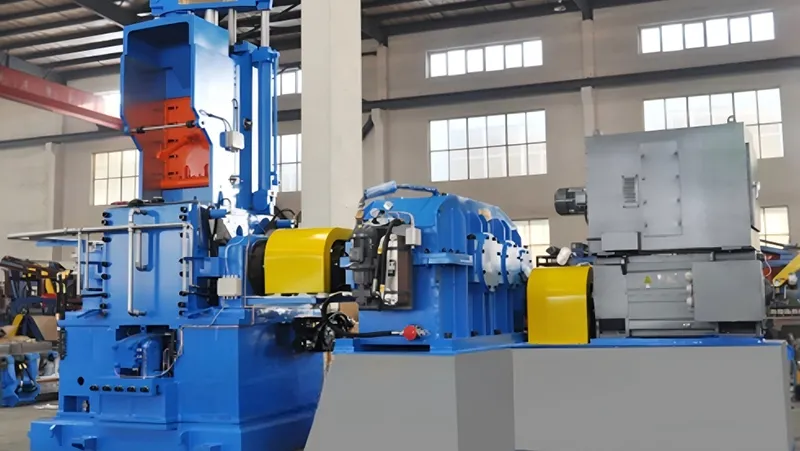
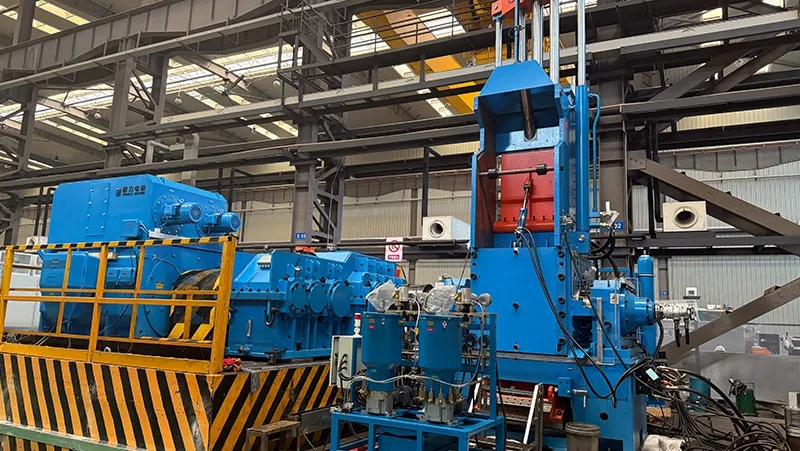
Intermeshing mixers use cylindrical intermeshing rotors to give rubber materials more even dispersion during mixing, while adjustable rotor speed allows the process to be matched more closely to different compound requirements. Suitable for both plasticizing and mixing, these mixers can sometimes turn a standard two-stage process into a single-stage one.
Technical Specifications
| Model | |||||||||||
| Total Mixer Volume (L) L | 5 | 20 | ~50 | ~90 | ~140 | ~200 | ~250 | ~330 | ~440 | ~580 | |
| Filling Factor (%) | ~0.65 | ~0.65 | ~0.65 | ~0.65 | ~0.65 | ~0.65 | ~0.65 | ~0.65 | ~0.65 | ~0.65 | |
| Rotor Speed (r/min) | 8-80 | 6-60 | 4.5-456-60 | 3-30, 4-405-50, 6-60 | 4-40、5-50 6-60 | 4-40、5-50 6-60 | 5-50 5.5-55 | 4-40 5-50 6-60 | 6-60 | 4.5-45 5-50 | |
| Specific Ram Pressure (MPa) | 0.45 | 0.5 | 0.5 | 0.55 | 0.58 | 0.58 | 0.58 | 0.62 | 0.58 | 0.58 | |
| Max. Production Capacity (t/h) | 0.08 | 0.32 | 0.72 | 1.36 | 2.2 | 3.04 | 3.9 | 5 | 7.6 | 10.3 | |
| Cooling Water Pressure (MPa) | 0.2-0.4 | 0.2-0.4 | 0.2-0.4 | 0.2-0.4 | 0.2-0.4 | 0.2-0.4 | 0.2-0.4 | 0.2-0.4 | 0.2~0.4 | 0.2-0.4 | |
| Cooling Water Consumption (m³/h) | 5 | 15 | 20 | 25 | 30 | 40 | 40-50 | 50-60 | 60-70 | 70-80 | |
| Main Motor Power (kW) | DC | 55 | 110 | 220,280 | 280,350 450,520 | 500,630, 750 | 750,1000 1100,1250 | 1250 | 1250, 1500 2×750 2×900 | 2×1250 | 2×1250 |
| AC | 55 | 110 | 250 | 280, 350 450, 500 | 500, 630 750 | 750, 1000 1120, 1250 | 1250 | 1250, 15001800 | 2300 2500 | 2500 2550 | |
| Overall Dimensions | Length (mm) | - | 3280 | 3910 | 3640 | 4400 | 5000 | 5150 | 5320 | 6240 | 6730 |
| Width (mm) | - | 1830 | 2435 | 2540 | 3100 | 3400 | 4000 | 4050 | 4300 | 4420 | |
| Height (mm) | - | 3300 | 3750 | 4615 | 5275 | 5600 | 6100 | 6460/6070 | 6350 | 7000 | |
| Weight (Excluding Motor and Gearbox) | (t) | 3 | 5 | 8.5 | 12 | 17 | 28 | 33 | 42/40 | 52 | 60 |
Features
- The mixing chamber has a sectional structure, which makes disassembly and maintenance easier.
- A drop-door discharge structure with hydraulic cylinders controls the opening and closing of the discharge door, while two reciprocating cylinders push the locking plate into place for secure sealing.
- Manual and automatic operation can both be selected through the PLC, depending on production requirements.