
Internal Mixer
In the 1980s, the comprehensive manufacturing technology of GK type internal mixers was introduced from the German Krupp WP Company (Werner & Pfleiderer), and China engineers were dispatched for systematic study and training in Germany. On this basis, continuous digestion, absorption and re-innovation were carried out, forming an internal mixer product system with international advanced level. The core features of the German technology introduced are as follows.
-
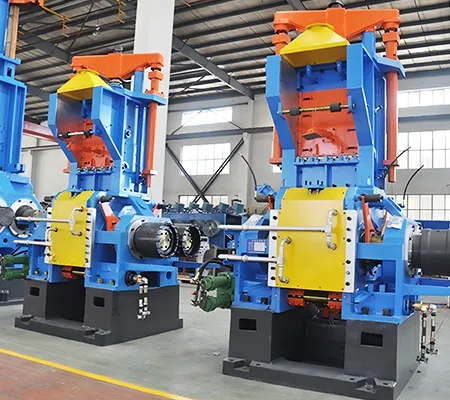
- Tangential Type Internal Mixer Tangential mixers are designed for mixing a wide range of rubber compounds. Their elliptical tangential rotor creates strong shearing action inside the chamber, allowing the materials to be worked more thoroughly and mixed more evenly. View details
-
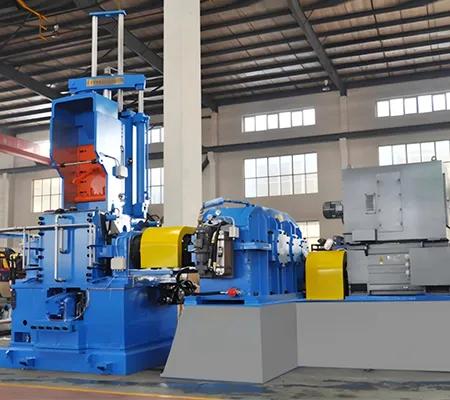
- Intermeshing Type Internal Mixer Intermeshing mixers use cylindrical intermeshing rotors to give rubber materials more even dispersion during mixing, while adjustable rotor speed allows the process to be matched more closely to different compound requirements. Suitable for both plasticizing and mixing, these mixers can sometimes turn a standard two-stage process into a single-stage one. View details
-
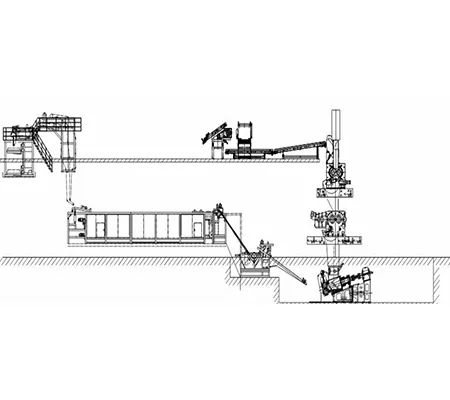
- Tandem Mixer Tandem mixers have two intermeshing type mixing units arranged vertically inside a fully enclosed structure, so the rubber compound moves directly from the first stage to the second with very little dust released into the workshop. View details
-
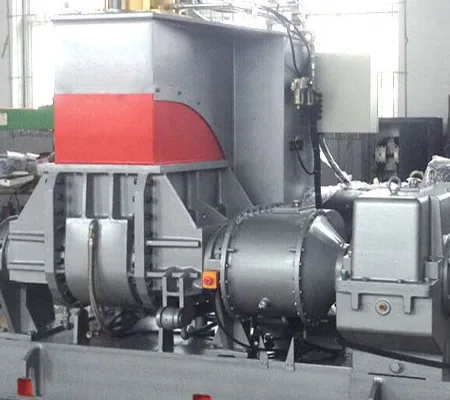
- Rubber Kneader Machine Kneader machine consists of body welded with high quality steel plates and two pieces of side plates. The chamber, rotors and piston ram are all jacketed structure for the ingoing of steam, oil and water for heating and cooling to suit the various requirement for the process of mixing and plastication. View details
- Building-block structure design
The entire machine adopts a modular assembly structure, which can rotate 180°, facilitating adaptation to different installation sites and enhancing maintenance convenience - Diverse rotor forms
Supports intermeshing type (E type), four-wing tangential type (N type), ZZ2 type, PES3, PES5, six-wing and other types of rotors, suitable for the plasticizing, mixing and final mixing requirements of different rubber compounds (such as radial tire rubber compound, silica rubber compound, etc.). - High-efficiency cooling system
All parts in contact with the rubber compound are cooled by water circulation and equipped with a constant temperature water temperature regulation system to ensure stable temperature during the rubber mixing process and guarantee the quality of the rubber compound. - Advanced transmission system
It adopts DC motor stepless speed regulation or AC motor + gearbox gear shifting and speed regulation, combined with high-precision hardened reducer and drum gear coupling, to achieve smooth transmission, low noise and long service life. - Intelligent PLC control system
Supports manual/automatic switching, can precisely control time, temperature and energy parameters, and is equipped with signal detection, feedback and safety protection functions, improving the consistency of rubber mixing and reducing labor intensity. - Flexible top ram and sealing method
The top ram can be pneumatically or hydraulically driven. The rotor shaft end seal offers mechanical or hydraulic sealing options to meet the requirements of different working conditions.
With over 20 years of deep-rooted expertise in the rubber and tyre industry, we specialize in delivering integrated rubber processing machinery solutions that span the entire production cycle, from internal mixing and extrusion to building and final curing. We are a trusted partner to global manufacturers of tires, conveyor belts, rubber tracks, rubber sheets, air springs, and other industrial rubber products. Understanding that no two production environments are the same, we offer high-level customization in rubber processing equipment specifications and automation degrees. Whether you need to optimize an existing layout or build a new rubber tire manufacturing plant, our engineering excellence ensures your specific production goals are met with precision and reliability.